
Strengthening Your Family Bond: Parent-Child Activities That Work
Parent-child bonding activities are more than feel-good moments—they're essential building blocks for your child's emotional health and your family's long-term resilience. Research shows that each additional hour of quality parent-child time reduces the probability of below-average well-being in children by 0.21% and increases the likelihood of excellent well-being by 1.62% (Li & Guo, 2023). The activities you choose and how you engage during them matter deeply—not just for creating happy memories, but for shaping how your child learns to regulate emotions, communicate needs, and trust relationships.
Many parents struggle to find meaningful connection time amid busy schedules, behavioral challenges, or simply not knowing where to start. The good news? Bonding doesn't require elaborate plans or hours of time. Even 10 to 15 minutes of focused, child-led interaction each day can transform your relationship and support your child's mental health in measurable ways.
Why Do Parent-Child Bonding Activities Matter for Mental Health?
The quality of the parent-child relationship shapes every area of a child's development—from emotional regulation to academic performance to how they'll form relationships throughout life. When parents and children engage in bonding activities together, several important things happen:
Connection becomes predictable. Children thrive on routines they can count on. Regular bonding rituals—whether it's bedtime reading, a Saturday morning pancake tradition, or a quick game before dinner—create a sense of safety and belonging that reduces anxiety and builds confidence.
Emotional regulation improves. As LaKisha Hoffman, MSW, notes in her work on co-regulation, "The best way to teach is to model" (Child Mind Institute). When you stay calm and present during bonding activities, even when your child is frustrated or upset, you're teaching them how to manage their own emotions through direct observation and mutual regulation.
Communication opens up. Activities that don't feel like "serious talks" often become the moments when children share what's really on their minds. Play, movement, and shared tasks lower defensiveness and create natural openings for conversation that wouldn't happen during direct questioning.
Trust deepens. When a parent consistently shows up for small moments—not only during crises or good behavior—children learn that their relationship can bend without breaking. This trust becomes the foundation for navigating harder developmental stages, from school transitions to adolescence.
What Types of Activities Build the Strongest Bonds?
Research identifies two main categories of quality time that support child well-being: enrichment activities (like singing together, reading books, or doing crafts) and daily routines (such as having meals together or helping with bedtime). Both matter, and both offer different benefits.
Child-led play gives your child control in a safe space. Set aside 10 to 15 minutes where your child chooses the activity and you follow their lead without directing, teaching, or correcting. This might feel uncomfortable at first, especially if you're used to guiding your child's choices, but it's one of the most powerful ways to rebuild connection after conflict or behavioral struggles.
Physical activities together benefit both parents and children. A study of families with children on the autism spectrum found that after a 10-week parent-child physical activity program, parents showed significant improvements in depression, anxiety, stress, and parenting stress measures compared to a control group (Zhao et al., 2021). Activities like bike rides, backyard games, family walks, or even indoor dance parties offer dual benefits: movement improves mood and nervous system regulation, while shared participation strengthens the relational bond.
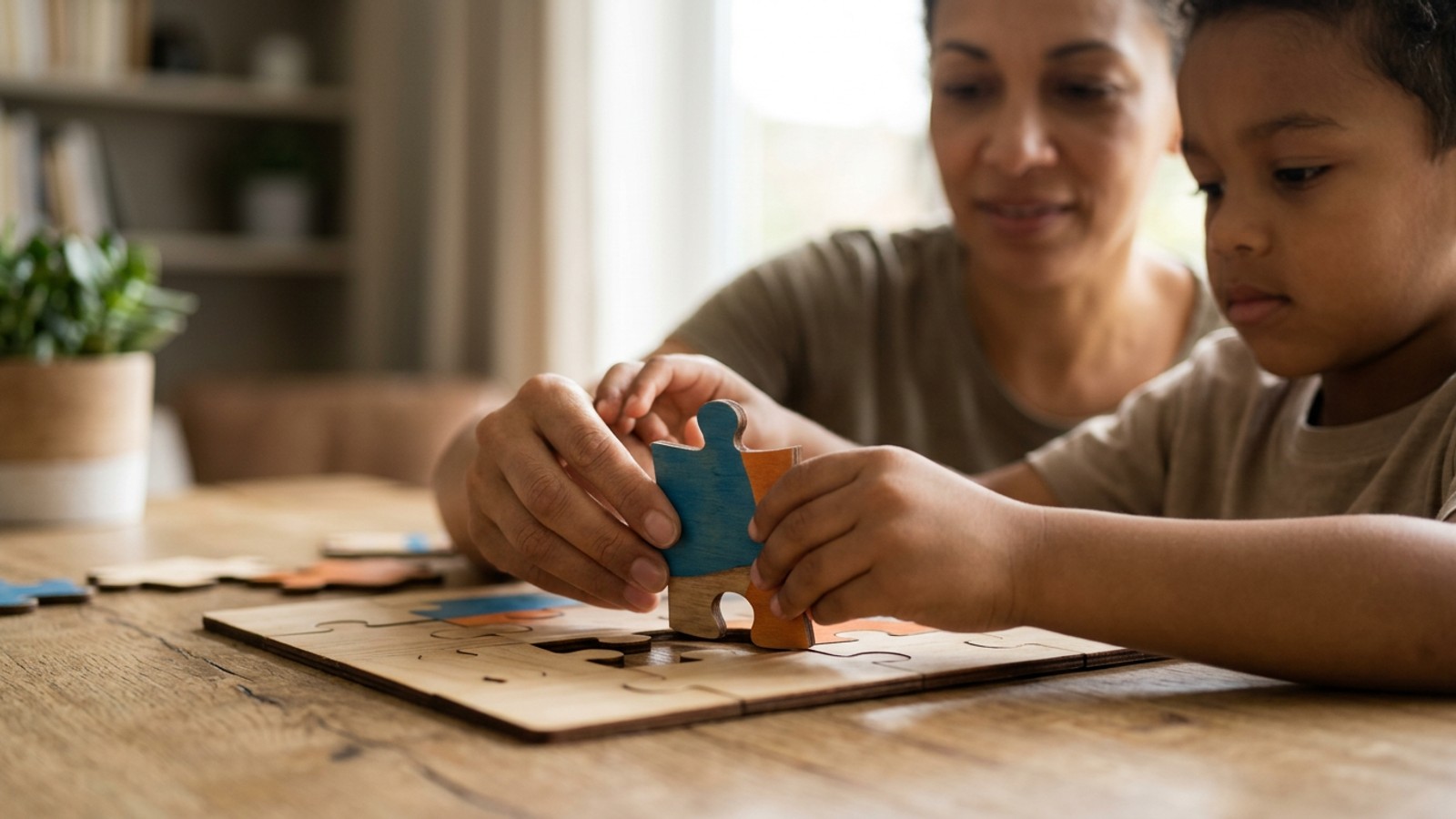
Cooperative games and projects teach teamwork and shared problem-solving. Choose activities where you work toward a common goal rather than competing against each other—building a puzzle together, cooking a meal as a team, or creating a "beat the clock" tidying challenge. These experiences shift you and your child from adversarial positions (often the pattern during behavior correction) into partners with a shared purpose.
Emotion-focused conversations during calm moments prepare your child for harder times. Practice naming feelings together: "I notice you seem excited about tomorrow" or "That sounded frustrating when your block tower fell." When children learn to label emotions during low-stress moments, they're better equipped to communicate their needs during meltdowns or conflicts.
How Much Time Do We Actually Need?
Parents often worry they're not spending enough time with their children, but research shows that quality trumps quantity. It's not about logging hours—it's about how present and engaged you are during the time you do have together.
The Child Mind Institute recommends starting small: aim for 5 minutes per day with younger children and 15 minutes with teens. Let your child choose an activity they enjoy, and focus on active listening while letting them lead the conversation. Fill this time with positive connection—no rules, commands, or corrections. Just presence.
For families where one or both parents work long hours, this is encouraging news. You don't need to overhaul your schedule; you need to protect small pockets of focused time and use them intentionally. A consistent 15-minute ritual before bed or after dinner can have more impact than sporadic, distracted hours together.
What Makes Bonding Time "Quality" Time?
Not all time together creates the same depth of connection. Quality bonding activities share a few key characteristics:
Phones and distractions are away. Even glancing at notifications signals to your child that something else matters more than they do in that moment. Put devices in another room.
Your child's interests take priority. Bonding isn't about teaching your child what you think they should enjoy—it's about entering their world with curiosity. If your six-year-old wants to line up toy cars for the tenth day in a row, follow that lead. Your interest in them is what matters.
Connection comes before correction. Save behavior guidance, homework reminders, and teaching moments for other times. Bonding activities are about relationship first. When you consistently choose connection over correction during these moments, your child learns that your love isn't conditional on perfect behavior.
You match your child's energy and emotions. Co-regulation—the mutual exchange of calm between parent and child—happens naturally during bonding time when you tune into your child's emotional state. If they're silly, join the silliness. If they're quiet and focused, match that stillness. This attunement tells your child, "I see you, and I'm with you."
How Can Bonding Activities Help When We're Already Struggling?
Many families seek counseling when relationships feel strained—constant conflict, defiance, emotional distance, or behaviors that seem out of control. In these situations, intentional bonding activities become even more critical because they offer a way to rebuild trust outside the conflict cycle.
Start where you are, not where you wish you were. If your relationship with your child feels tense, 15 minutes of forced play won't fix it overnight. Begin with 5 minutes. Commit to showing up without an agenda other than connection. Your child will likely test whether this new pattern is real—keep showing up anyway.
Use repair as a bonding opportunity. After conflicts or moments when you've lost your temper, a brief, genuine reconnection—"I didn't like how I spoke to you earlier. You didn't deserve that tone. Can we try again?"—teaches your child that relationships can recover from ruptures. This is its own form of bonding: you're showing them that mistakes don't end connection.
Seek support when patterns feel stuck. Sometimes families need help identifying which activities will work best for their specific child, or how to practice co-regulation when a parent's own stress or trauma history gets in the way. Therapy offers guidance on tailoring bonding strategies to your child's age, temperament, and needs, along with support for parents navigating their own emotional responses.
If your family is experiencing ongoing conflict, behavioral challenges, or emotional distance, family counseling can help you develop a clear plan for rebuilding connection. Many families find that when bonding becomes consistent, other behavior struggles naturally improve because the underlying need for connection is being met.
What If My Child Resists Bonding Time?
It's common for children—especially those who've experienced inconsistent connection or who are neurodivergent—to initially resist or test new bonding routines. They may act disinterested, push boundaries during the time, or seem uncomfortable with your full attention.
Keep showing up. Resistance often means your child is unsure whether this new pattern is safe or sustainable. Consistency proves that your commitment to connection is real, not conditional on their immediate response.
For teens, bonding looks different but matters just as much. They may not want to sit and play a game, but they might open up during a car ride, while cooking together, or during a walk. The key is offering your presence without pressing for conversation—teens talk when they feel ready, not when interrogated.
Moving Forward: Small Steps, Big Impact
Bonding doesn't happen in one big moment—it's built through small, repeated experiences that help your child feel safe, seen, and understood. Whether you're starting fresh or strengthening an already solid relationship, the activities you choose matter less than the consistency and presence you bring to them.
If you're struggling to find connection with your child, experiencing frequent conflict, or unsure where to begin, you don't have to figure it out alone. Life Enrichment Counseling Center offers family and child counseling in Gainesville, Alexandria, Haymarket, and Port St. Lucie, along with telehealth options for families across Virginia and Florida. Dr. Beverley Boothe, Ph.D., MSW, LCSW, and our team of experienced therapists can help you develop bonding strategies tailored to your family's unique needs and strengths. Reach out today to schedule a consultation and take the first step toward a stronger, more connected family relationship.
References
Child Mind Institute. (n.d.). What is co-regulation? https://childmind.org/article/what-is-co-regulation/
Li, D., & Guo, X. (2023). The effect of the time parents spend with children on children's well-being. Frontiers in Psychology, 14, Article 1096128. https://www.frontiersin.org/journals/psychology/articles/10.3389/fpsyg.2023.1096128/full
Zhao, M., You, Y., Chen, S., Li, L., Du, X., & Wang, Y. (2021). Effects of a web-based parent–child physical activity program on mental health in parents of children with ASD. International Journal of Environmental Research and Public Health, 18(23), Article 12586. https://pmc.ncbi.nlm.nih.gov/articles/PMC8700830/