What Twenty Years of Family Therapy Taught Us About 'Just Talking': Why Some Children Need More Than Words
Mental Health Awareness Month brings a flood of messages urging families to "talk about mental health," "open up about feelings," and "start the conversation." The intent is good—reducing stigma matters. But twenty years of working with children, adolescents, and families across Northern Virginia and Florida has taught us something the awareness campaigns rarely say: for a significant number of children, "just talking" isn't the path to healing. It's a barrier.
Not every child is a verbal processor. Not every struggle translates cleanly into words. And the cultural insistence that therapy equals talking can keep families from finding the help that actually fits their child.
When "Use Your Words" Becomes the Wrong Instruction
The push to verbalize feelings starts early. We tell toddlers to "use your words" when they're frustrated. We praise children who can articulate what's bothering them. Schools reward verbal participation. By the time a child reaches therapy age, the assumption is set: you sit across from someone, you talk about your problems, and that's how you get better.
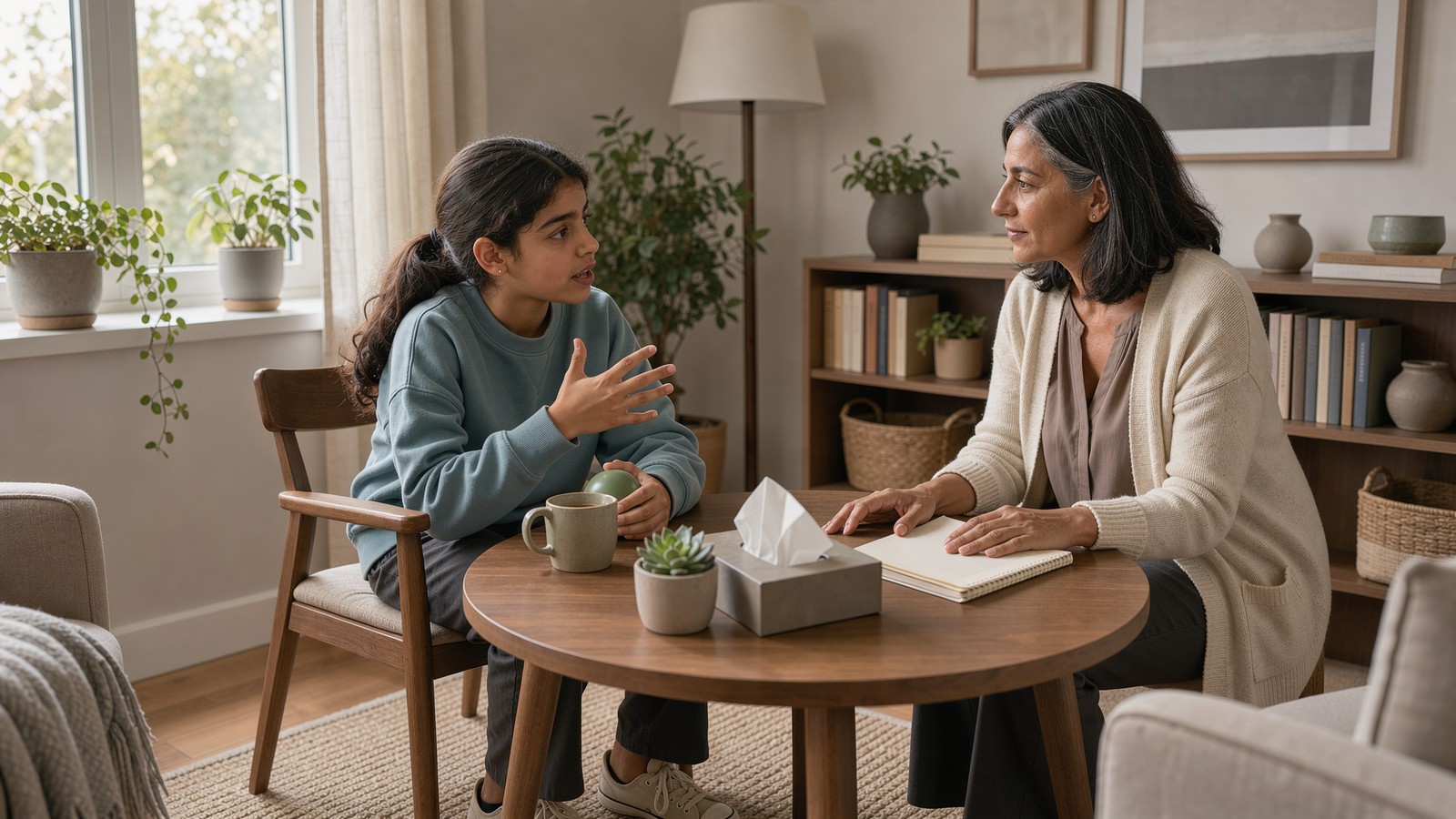
For some children—particularly older school-age kids, teens, and adults—that model works. But for many others, it doesn't. Young children lack the vocabulary and abstract thinking required to discuss complex emotions. A six-year-old experiencing anxiety after a family separation may only know that their stomach hurts before school, not that they're worried about who will pick them up or whether their parents still love them. Asking them to "tell me how you feel" can produce silence, frustration, or a simple "I don't know"—not because they're resistant, but because the cognitive infrastructure to translate felt experience into speech isn't fully built yet.
Trauma compounds the challenge. Children who have experienced abuse, neglect, or frightening events often cannot access those memories through language. The brain stores traumatic material differently, bypassing the verbal centers entirely. Asking a trauma survivor to narrate what happened can retraumatize them or shut them down completely. For these children, talk therapy isn't just ineffective—it can feel actively unsafe.
And then there are the children who simply process the world through action, image, and metaphor rather than linear verbal explanation. They're not developmentally delayed. They're not refusing to engage. They're thinking in a language therapy hasn't traditionally honored.
What Play Therapy, Art Therapy, and Music Therapy Offer That Words Cannot
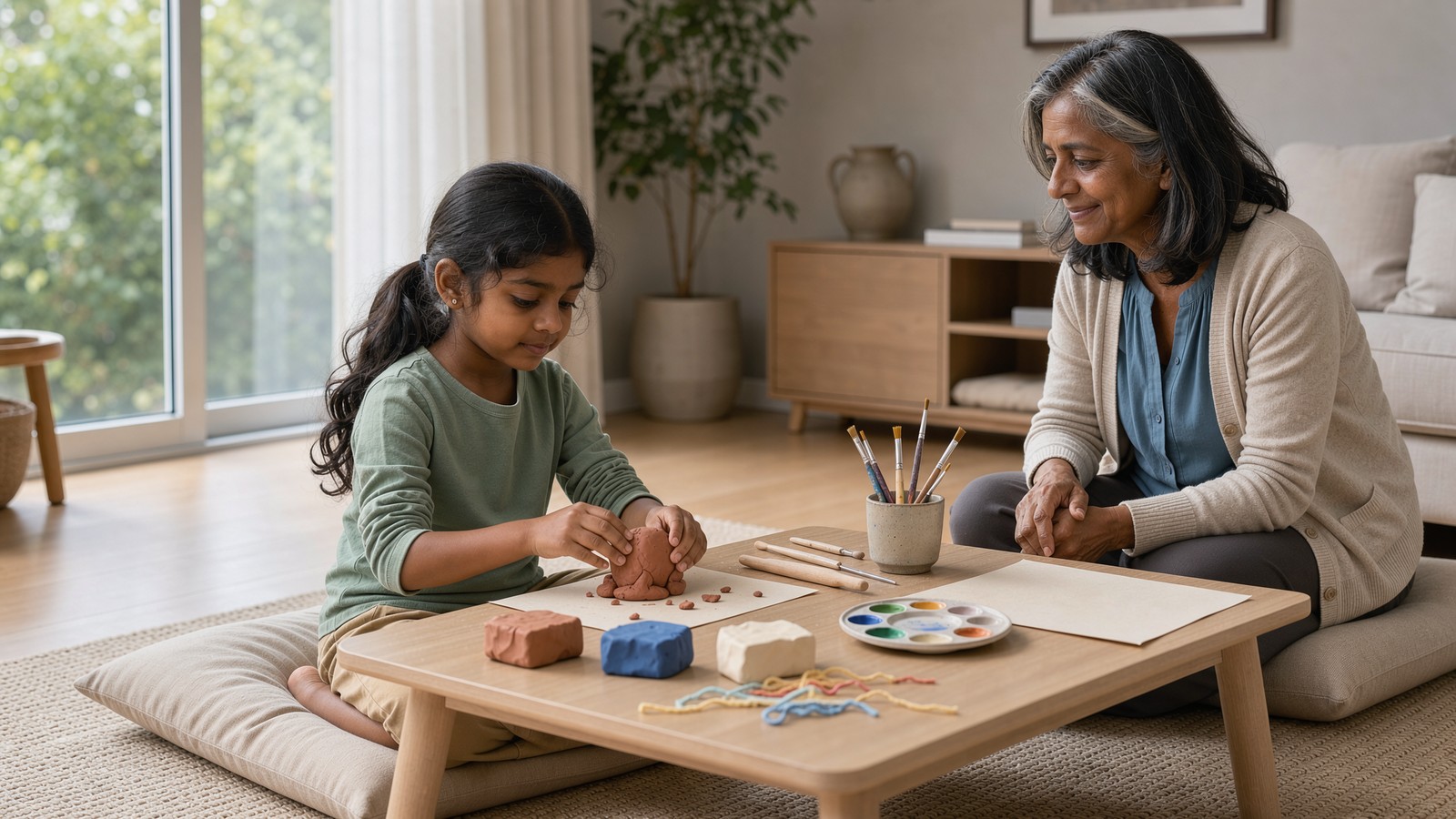
Creative and expressive therapies—play therapy, art therapy, music therapy—don't ask children to translate their inner world into adult language. They meet children in the language they already speak.
Play therapy, grounded in decades of research, uses toys, dolls, sand trays, and structured activities to let children communicate symbolically. A child who cannot describe their fear of their parents' fighting might stage a scene with toy animals where the big bear and big lion roar at each other while the baby bear hides. That's not evasion. That's precision. The therapist can work with that material—validating the baby bear's fear, exploring what the baby bear needs to feel safe—without forcing the child to say "I feel scared when my parents yell."
The research backs this up. A comprehensive meta-analysis of 93 controlled studies found that children who received play therapy showed a 0.80 standard deviation improvement over children who did not—a large, clinically meaningful effect (Bratton et al., 2005). Play therapy worked equally well across age, gender, and presenting issue, whether children were struggling with anxiety, trauma, behavioral challenges, or grief. When parents were involved through filial therapy, effects were even stronger, reaching 1.15 standard deviations.
Art therapy offers similar access for children and teens who think visually or who need the physical act of creation to externalize what they're carrying. A 2024 systematic review and meta-analysis found that visual arts therapy was effective in reducing PTSD symptoms specifically in children who had experienced trauma (Maddox et al., 2024). Painting a swirl of dark colors or sculpting a figure that represents "the scared part of me" gives form to what cannot yet be named, and from there, healing can begin.
Music therapy works through rhythm, melody, and lyric to help children regulate emotions, practice social skills, and process difficult experiences. For children on the autism spectrum, with ADHD, or with language delays, music provides structure and emotional resonance that words alone cannot.
These aren't lesser substitutes for "real" therapy. They are valid, evidence-based treatments that recognize how different minds and developmental stages actually work.
The Cost of the "Talking Cure" Assumption
Here's what we see when families assume therapy must mean talking: they delay seeking help for young children, waiting until the child is "old enough to talk about it." By the time they arrive, the problem has often worsened. Or they start traditional talk therapy, the child shuts down or says "I don't know" to every question, and the parents conclude therapy "doesn't work" for their child. The child internalizes the message that they're the problem—they can't do therapy right.
We also see it in schools and pediatrician offices. A teacher refers a seven-year-old for counseling because of aggressive outbursts. The intake form asks the child, "Why do you think you hit your classmate?" The child has no answer—not because they're being defiant, but because the connection between their own overwhelming feelings and the physical reaction hasn't been made conscious yet. Without access to play or art-based expression, the referral goes nowhere, and the behavior continues.
And we see it in insurance and policy conversations, where "evidence-based treatment" is sometimes narrowly interpreted as cognitive-behavioral talk therapy, leaving creative modalities to fight for recognition and reimbursement despite decades of research support.
What Families Should Know
If your child is struggling and traditional talk therapy hasn't helped—or if you sense your young child needs support but can't yet articulate what's wrong—creative therapies may be the better fit. Here's what to look for:
For children under 10, start with play therapy. This is the developmentally appropriate therapeutic language for young children. Look for a licensed therapist with specialized training in play therapy approaches.
For children and teens who are visual thinkers, consider art therapy. If your child gravitates toward drawing, painting, or building when they're upset, art therapy can harness that natural outlet therapeutically.
For children with sensory, language, or developmental differences, explore music therapy. Rhythm and melody can provide structure and emotional access that other modalities can't.
For trauma, prioritize modalities that don't require verbal narration. Trauma-focused art therapy, play therapy, and EMDR (Eye Movement Desensitization and Reprocessing) allow children to process traumatic material without having to tell the story aloud.
Trust your child's response. If your child dreads therapy sessions or consistently says "I don't want to talk about it," that's information. A different modality might change everything.
The Real Conversation We Need
Mental Health Awareness Month's call to "talk about mental health" is an important cultural shift. But awareness campaigns aimed at reducing stigma shouldn't accidentally create new barriers by implying there's only one right way to do therapy.
Some children heal through talking. Others heal through playing out their fears with dolls, painting their anger onto canvas, or drumming out their grief. All of those paths are valid. All of those paths are therapy. And the families who choose creative modalities aren't settling for second-best—they're choosing the treatment that actually matches how their child's mind works.
After twenty years in this field, we'd offer this revision to the awareness-month message: Don't just talk about mental health. Meet each person—especially each child—in the language they actually speak. Sometimes that language is words. Often, it's something richer.
If you're wondering whether your child might benefit from play therapy, art therapy, music therapy, or another creative approach, reach out. Life Enrichment Counseling Center offers a range of evidence-based modalities designed to meet children, teens, and families exactly where they are. We serve families in Gainesville, Alexandria, and Haymarket, VA; Port St. Lucie, FL; and online across Virginia and Florida. To schedule a consultation with Dr. Beverley Boothe, Ph.D., MSW, LCSW, and our team of specialized therapists, visit our contact page or call (703) 754-0636.
References
Bratton, S. C., Ray, D., Rhine, T., & Jones, L. (2005). The efficacy of play therapy with children: A meta-analytic review of treatment outcomes. Professional Psychology: Research and Practice, 36(4), 376–390. https://www.researchgate.net/publication/232438673_The_Efficacy_of_Play_Therapy_With_Children_A_Meta-Analytic_Review_of_Treatment_Outcomes
Maddox, G. A., Bodner, G. E., Christian, M. W., & Williamson, P. (2024). On the effectiveness of visual arts therapy for traumatic experiences: A systematic review and meta-analysis. Clinical Psychology & Psychotherapy, 31(4), e3041. https://onlinelibrary.wiley.com/doi/full/10.1002/cpp.3041